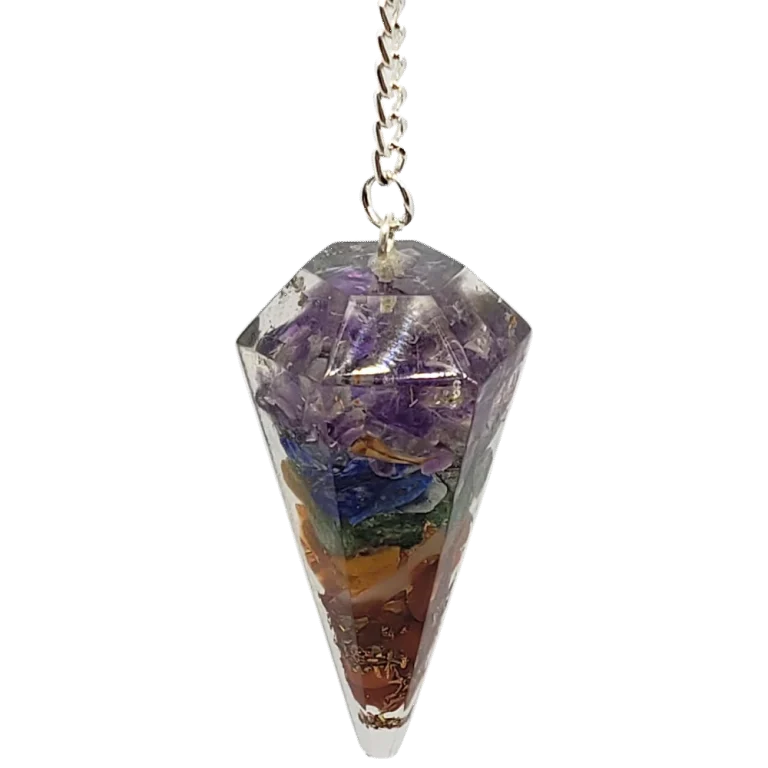
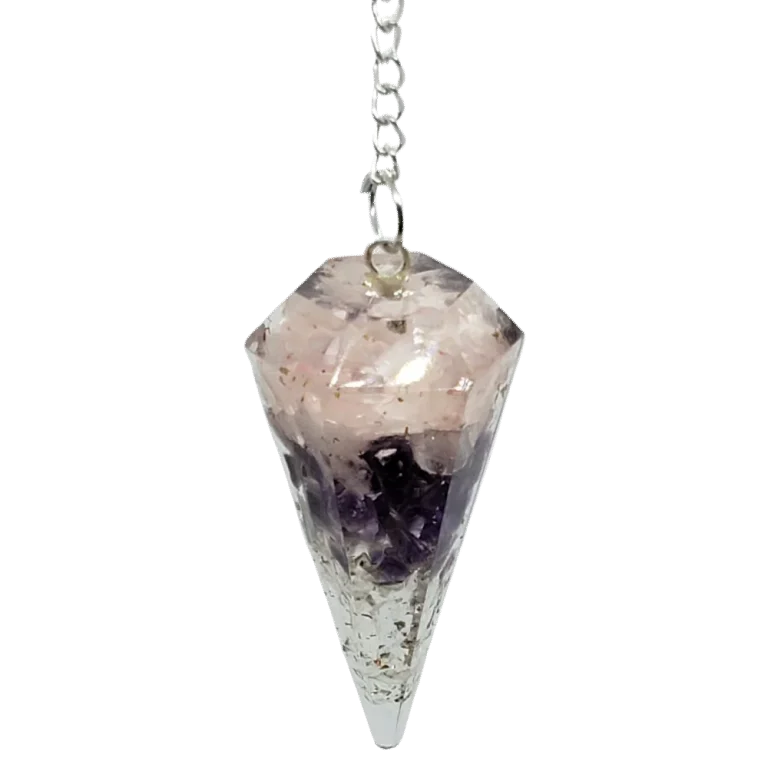
How do orgone pendulums work, and what makes them different from conventional pendulums? An orgone pendulum combines a traditional dowsing instrument with orgonite, a material typically made from resin, metal, crystals, gemstones, and other organic and inorganic materials. In addition to functioning as a pendulum, orgonite is believed to interact with the subtle energy around it, giving an orgone pendulum properties quite different from those of a conventional pendulum.
When I first began researching orgone pendulums, I accepted much of the general information about how orgonite was believed to work. Wilhelm Reich’s concept of orgone, the use of organic and inorganic materials, the transformation of negative orgone into positive orgone, and the piezoelectric properties of quartz all seemed to provide pieces of the explanation.
But the more questions I asked, the less certain I became that all those pieces fit together in quite the way they are commonly described.
That doesn’t necessarily mean the explanations are wrong. There may be answers I simply haven’t encountered. But questioning them led me to consider some other possibilities. Does orgonite really need negative energy in order to function? What role do the different materials actually play? Why do makers use different crystals and gemstones if they don’t contribute their own energetic properties? And is the universal energy Reich called orgone necessarily a separate form of energy, or could it be another way of understanding the subtle energy once described as aether?
These questions also caused me to reconsider what actually makes an orgone pendulum different. Does the orgonite change the dowsing itself, or does it add a separate energetic influence to an otherwise conventional dowsing instrument?
In this article, we’ll go back to Reich’s original ideas, look at how modern orgonite developed, examine the role of its different materials and crystals, and question some of the explanations for how it works. Along the way, I’ll offer a somewhat different perspective on what an orgone pendulum may actually be doing—and what, if anything, that means when we use one for dowsing.
What Did Wilhelm Reich Mean by Orgone?
The concept of orgone energy originated with Austrian physician and psychoanalyst Wilhelm Reich. His early work grew out of psychoanalysis and his interest in the relationship between emotional states, the body, and biological energy. By the late 1930s, his research had led him to conclude that he was observing a form of energy different from electricity, which he eventually named orgone energy.
Reich’s concept eventually extended far beyond the human body. He believed orgone was present in living organisms, in the atmosphere, and throughout nature. In other words, orgone was not simply a human “life force.” He came to regard it as a universal energy present throughout the environment, with both biological and cosmic functions.
This distinction is important when trying to understand an orgone pendulum. Orgone is sometimes compared with Chi, Prana, and other traditional concepts of vital energy, but I don’t think these terms should automatically be treated as different names for the same thing. Chi and Prana developed within their own philosophical and healing traditions and have meanings that extend beyond Reich’s concept of orgone.
To me, orgone bears a closer resemblance to the older concept of aether—an invisible medium or subtle energy believed to permeate space. I am not suggesting that Reich proved orgone and aether are the same thing, or even that Reich’s theory was derived from the concept of aether. But if orgone exists throughout living and nonliving matter and the surrounding environment, the comparison seems worth considering.
This also raises a question that will become important as we look at orgonite: if orgone is already present everywhere, does an orgone device actually create energy, or does it collect, concentrate, organize, or otherwise alter energy that is already there?
Reich himself appears to point us toward the latter possibility. His orgone energy accumulator was designed to collect and concentrate atmospheric orgone using alternating organic and metallic materials. He wasn’t attempting to manufacture orgone from nothing; he believed he was working with an energy already present in the surrounding environment.
Positive and Negative Orgone Energy
Reich believed that orgone could exist in different states. Free-flowing, life-supporting orgone became known as Positive Orgone Energy (POR), while he used the term Deadly Orgone Energy (DOR) to describe a disturbed or harmful state of orgone.
I think it is important not to picture POR and DOR as two completely different kinds of energy. If orgone is a universal energy that exists throughout the atmosphere and surrounding environment, perhaps positive and negative describe different conditions within the same underlying energetic field.
An analogy might be water. Clean, freely flowing water can support life, while the same water can become stagnant or contaminated and have a detrimental effect. We don’t consider them two fundamentally different substances. Something in the environment has changed the condition of the water.
I am inclined to think of orgone in much the same way. In its natural state, the universal energy surrounding the Earth may be fundamentally positive and life-affirming. Local environmental conditions, however, may interfere with its natural flow or otherwise alter its energetic characteristics, producing what we experience as a negative zone.
What Makes an Energy Zone Negative?
This raises another question: what do we actually mean when we call an energy positive or negative?
From a human perspective, we tend to call an energetic condition positive when it supports our well-being and negative when it appears detrimental. But that distinction may not be absolute.
Geopathic energy lines provide an interesting example. Some locations that are considered unfavorable for prolonged human exposure are avoided by certain animals, while other species may be quite comfortable with them. Bees, for example, are traditionally observed by some dowsers to favor particular geopathic zones for their hives. If an energetic condition is detrimental to humans but favorable to another organism, is the energy itself really “bad”?
Perhaps positive and negative are partly descriptions of how a particular energetic condition interacts with a particular living organism.
This is particularly relevant when dowsing a house. I may find one location that tests positively and another nearby that tests negatively. Both can exist within the same building and, presumably, within the same universal energetic matrix.
The purpose of space clearing is then not necessarily to remove a substance called negative energy. It may instead be to identify and correct conditions that are interfering with the natural energetic balance of the space.
Depending on the situation, this might involve removing clutter to encourage better energetic flow, applying Feng Shui principles, or using energetic devices such as Lakhovsky coils or the ADR products I use in my own work. Different methods may approach the problem differently, but the objective is similar: alter the conditions that are contributing to an undesirable energetic environment.
What Causes These Disturbances?
There may be many influences acting upon the energy of a location at the same time.
Natural geological features and geopathic lines may be one source of influence. Building materials, room configuration, electrical wiring and electromagnetic fields may contribute others. Clutter and restricted movement through a space may affect its energetic flow. The people and other living organisms occupying the environment may introduce still more influences.
Rather than imagining separate pools of POR and DOR, I think it may be more useful to picture one continuous energetic matrix containing overlapping local influences. A location that normally has a positive energetic quality could therefore become altered by one or more environmental factors.
This would also give the idea of stagnant energy a somewhat different meaning. The underlying orgone doesn’t necessarily cease to exist or literally stop moving. Instead, something in the local environment may be interfering with its natural flow or expression, creating a condition that we experience as stagnant or negative.
In that sense, there is an interesting parallel with electromagnetic pollution. Electricity itself isn’t inherently negative, yet the placement of wiring, electrical equipment, frequencies, and the fields they produce can create very different electromagnetic environments within the same building.
Does Orgonite Always Transform DOR into POR?
This brings us to an important question about orgonite.
It is commonly said that orgonite transforms DOR into POR. But if POR and DOR are actually local conditions of the same universal energy, perhaps that description is too simple.
What does an orgonite device do when it is already surrounded by positive, freely flowing energy? Does it stop functioning because there is no DOR to transform? Does it continue to radiate positive energy? Or does it interact with and perhaps amplify the energetic condition already present around it?
This question caused me to reconsider an experience I had while dowsing a home for negative energy. The house contained a number of orgone generators. When I tested them, some tested positive and others tested negative.
At the time, I interpreted this to mean that some of the generators had themselves become negative and might need to be cleared. But my dowsing hadn’t actually established that. It had only established that certain generators tested negatively where I found them.
I now wonder whether those generators may have been sitting within negative zones and reflecting, concentrating, or amplifying the energetic condition of their surroundings.
I can’t go back and perform the tests that would be necessary to answer that question. I would want to test the location independently, move the same generator between positive and negative zones, and determine whether its dowsing response changed accordingly. Nevertheless, the experience raises a possibility I hadn’t considered at the time.
Perhaps orgonite doesn’t simply take DOR in and send POR out. Its relationship with the surrounding energetic field may be considerably more dynamic than that.
That is the question we’ll return to when we look more closely at what orgonite may actually be doing.
From Orgone Accumulators to Orgonite
Reich’s experiments with orgone eventually led to the development of the orgone energy accumulator. These devices used alternating layers of nonmetallic insulating and metallic materials, commonly including fiberglass or similar insulating material together with steel wool, with a metal-lined interior. Reich believed that the different materials interacted with atmospheric orgone in different ways, causing the energy already present in the environment to become concentrated within the accumulator.
This is an important distinction: the accumulator was not intended to create orgone from nothing. It was intended to collect and concentrate energy that Reich believed was already present everywhere.
Several decades later, Karl Hans Welz took the organic/inorganic principle in a different direction. Instead of constructing an accumulator from separate layers, he mixed what he classified as an organic material, such as polyester or epoxy resin, with fine metal particles. Welz named the resulting material orgonite and described it as functioning like an orgone accumulator containing hundreds of extremely small layers.
This changes the structure considerably. In a Reich accumulator, the organic and inorganic materials are arranged in relatively large layers. In orgonite, countless particles of metal are surrounded by resin, creating a dense three-dimensional network of organic/inorganic interfaces throughout the material.
That raises an interesting possibility. If the interaction between organic and inorganic materials is fundamental to the way an orgone accumulator works, perhaps orgonite’s effectiveness comes partly from greatly increasing the number of places where that interaction can occur.
Modern orgonite, however, has evolved considerably beyond Welz’s basic resin-and-metal mixture. Quartz, gemstones, coils, minerals, and other materials are now commonly incorporated, and different makers offer different explanations for what these additions do. Even within the orgonite community, there is no single explanation. Some consider quartz essential, while others regard the resin-and-metal matrix itself as the fundamental orgonite material, with crystals modifying or refining its energetic properties.
This distinction becomes particularly important with an orgone pendulum. If resin and metal already interact with the surrounding orgone field, then the crystal may not be responsible for creating that interaction in the first place. It may be doing something else.
And that brings us to one of the most common explanations for the role of quartz in orgonite: the piezoelectric effect.
Does the Piezoelectric Effect Apply to Orgone Pendulums?
One explanation frequently given for the energetic properties of an orgone pendulum involves the piezoelectric effect of quartz. This is a genuine and well-understood physical property of quartz and certain other crystalline materials, although its role in orgonite is less certain.
When quartz is subjected to mechanical stress, its crystal lattice becomes slightly distorted, producing an electrical polarization across the crystal. The reverse also occurs: applying an electrical voltage can cause quartz to deform slightly. This relationship between mechanical and electrical energy is known as the piezoelectric effect.
Quartz watches provide a familiar example. The battery powers an electronic circuit that applies an electrical signal to the quartz crystal, causing it to vibrate at a very stable frequency. The circuit counts these oscillations to keep accurate time. Quartz is useful for this purpose because its highly ordered crystalline structure gives it predictable electrical and resonant properties.
Does Resin Keep Quartz Electrically Active?
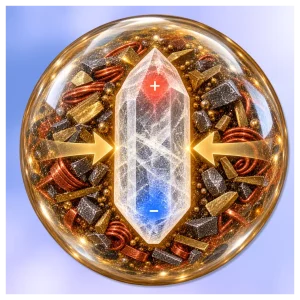
A common explanation for orgonite is that resin contracts as it cures, placing pressure on the quartz embedded within it. The resulting piezoelectric effect is then said to help the orgonite transform negative orgone energy into positive orgone energy.
There is a problem with this explanation.
Pressure applied to quartz can certainly produce electrical polarization. But once the pressure becomes constant, it does not provide a continuous supply of electrical energy. A changing mechanical force—such as vibration, repeated compression, or movement—is normally required to produce a continuing electrical output.
This doesn’t mean that compressing quartz within orgonite has no effect. The crystal is being held under mechanical stress, and that may alter some of its physical characteristics. But the simple explanation that permanent pressure from the resin produces a continuous piezoelectric output appears incomplete.
There is another difficulty. Even if we establish that a piezoelectric charge is present, we still have to explain the next step:
How does an electrical polarization in quartz transform DOR into POR?
Piezoelectricity explains how mechanical stress and electrical polarization can interact. It does not, by itself, explain an interaction with orgone energy.
Some researchers and orgonite makers have proposed more elaborate explanations. The Orgone Amplifier, for example, deliberately applies electrical pulses to quartz and uses its resonant properties as part of a proposed orgone-emission system. That is quite different from simply embedding a crystal in hardened resin. The Orgone Amplifier
Perhaps Piezoelectricity Isn’t the Main Reason for the Crystal
This brings me back to a more basic question. Why assume that the crystal’s primary purpose in orgonite is piezoelectric?
Crystals and gemstones have been attributed energetic properties for centuries, long before anyone understood piezoelectricity. Different stones are also believed to have different energetic characteristics. Clear quartz, rose quartz, and amethyst, for example, would not traditionally be regarded as energetically interchangeable simply because they are all varieties of quartz.
Perhaps piezoelectricity is one physical property of certain crystals used in orgonite without necessarily being the mechanism that makes orgonite work. Their crystalline structure, resonance, orientation, and individual energetic characteristics may be equally—or perhaps more—important.
This possibility becomes even more interesting when we remember that the resin-and-metal matrix is already intended to interact with orgone. If that matrix provides the basic interaction with the surrounding energy, the crystals could serve another function: organizing, modifying, directing, or imparting their own energetic characteristics to that energy.
What Role Do Crystals and Gemstones Play in Orgonite?
If the combination of organic and inorganic materials is already capable of interacting with orgone, an obvious question arises: why are crystals and gemstones added to orgonite at all?
Quartz is the crystal most commonly associated with orgonite, and its piezoelectric properties are frequently offered as part of the explanation. But as we have just seen, piezoelectricity doesn’t fully explain how a crystal would transform orgone. It also doesn’t explain why orgonite makers use different varieties of quartz or incorporate gemstones with very different properties.
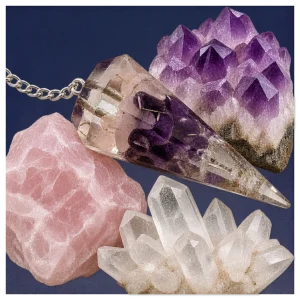
One of my orgone pendulums, for example, contains clear quartz, rose quartz, and amethyst. If the only purpose of these stones were to produce a piezoelectric effect, there would seem to be little reason for choosing this particular combination. All three are varieties of quartz, yet each is attributed distinctly different energetic properties.
Crystals Have Individual Energetic Signatures
The use of gemstones for their energetic properties is much older than orgonite. Different stones have long been associated with different influences in traditional gemology, crystal healing, and other metaphysical practices.
Rose quartz, for example, is associated with the heart chakra and with love, compassion, emotional healing, and emotional balance. Amethyst has quite different properties. It is associated with higher consciousness, enhanced intuition and psychic awareness, making it an excellent gemstone for inner growth and spiritual development. Clear quartz is commonly regarded as an amplifier of energy and is often used to strengthen or enhance the influence of other stones.
These distinctions are also one reason people choose a pendulum made from a particular gemstone. Someone may select a rose quartz pendulum for questions involving relationships, emotions, or matters of the heart, while an amethyst pendulum may be preferred for intuitive, psychic, or spiritual work. Clear quartz may be chosen for its versatility and amplifying properties.
In other words, the gemstone used to make a crystal pendulum isn’t merely decorative. Its particular energetic properties may be one of the reasons the pendulum was chosen in the first place.
This raises an interesting question when the same stones are incorporated into an orgone pendulum. If rose quartz or amethyst retains its individual energetic signature when used as a conventional crystal pendulum, why would those properties disappear when the stone is embedded in orgonite?
I don’t think they do.
Although clear quartz, rose quartz, and amethyst are all forms of quartz, they are not energetically identical. Each has its own characteristic influence, and I believe that influence continues to be present when the stone becomes part of an orgonite device.
There is also an interesting physical counterpart to at least part of this idea. Crystals have highly ordered structures rather than random arrangements of atoms. Quartz consists of a repeating three-dimensional crystalline lattice, and its orientation and cut can affect measurable optical, resonant, electrical, and piezoelectric properties. This doesn’t explain the metaphysical properties attributed to different gemstones, but it does demonstrate an important principle: the structure and orientation of a crystal can affect the way it interacts with energy.
Could Crystals Modify the Orgone?
This leads me to a different way of considering the purpose of crystals in orgonite.
Rather than assuming that quartz creates orgone through piezoelectricity, perhaps the resin-and-metal matrix provides the primary interaction with the ambient orgone, while the crystals modify the character of the energy passing through or interacting with that matrix.
They might organize or focus the energy, influence the way it radiates from the orgonite, or impart some of their own energetic characteristics to it. If so, the particular gemstones used in an orgonite device would matter.
An orgonite device containing rose quartz might therefore have different energetic characteristics from one containing amethyst. An orgone pendulum containing several gemstones could combine their different influences with the effects produced by the resin-and-metal matrix.
This also suggests that simply adding more gemstones isn’t necessarily better. Traditional systems of gemstone use sometimes maintain that particular stones complement one another while others may interfere with or counteract each other’s effects. If gemstones retain their individual energetic signatures within orgonite, the selection and combination of stones may be just as important as their presence.
We still haven’t established exactly how crystals interact with orgone. But I think looking at them merely as piezoelectric components is too limiting. Their crystalline structure, individual energetic signatures, orientation, and relationship with the other materials may all contribute to the resulting energy of the finished device.
What Might Orgonite Actually Be Doing?
Having looked at Reich’s accumulators, the organic and inorganic structure of orgonite, the piezoelectric properties of quartz, and the individual energetic signatures of gemstones, we can return to the central question: what might orgonite actually be doing?
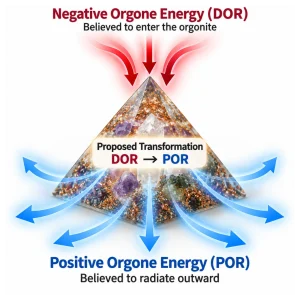
The common explanation is that orgonite attracts DOR, transforms it into POR, and radiates positive orgone back into the surrounding environment. I originally accepted this explanation without giving much thought to the actual process involved. The more I questioned it, however, the less complete it seemed.
If orgone—or perhaps aether—is a universal energy already permeating the environment, orgonite shouldn’t need to create it. Nor is it clear why a device would selectively draw DOR toward itself while leaving POR unaffected.
Perhaps the starting point should be simpler: orgonite interacts with the energetic condition already present in its surroundings.
Transformation, Amplification, or Both?
Reich’s accumulator was intended to concentrate atmospheric orgone. Modern orgonite greatly increases the number of organic and inorganic interfaces by distributing metal throughout a resin matrix. This could conceivably intensify the interaction with the surrounding energetic field.
But concentration doesn’t necessarily mean transformation.
If an orgonite device is placed in a positive energetic environment, perhaps it concentrates or amplifies that positive condition. If it is placed within a negative zone, could it also concentrate or amplify the disturbed condition already present?
My earlier experiences with orgone generators that tested both positively and negatively make me reluctant to dismiss this possibility.
There is also another possibility: orgonite may both amplify and modify the energy with which it interacts.
Its resin-and-metal matrix could concentrate the ambient energy, while its crystals, gemstones, geometry, proportions, and other components influence the characteristics of the resulting field. Under this model, orgonite wouldn’t simply be a passive amplifier. Its construction would help determine what happens to the energy as it interacts with the device.
This could also explain why the size and construction of an orgone device might matter. A larger or more densely constructed piece might have a greater range or strength of influence, while different materials could change the characteristics of that influence.
The Environment May Be Part of the Equation
I think this is an important element that many simple explanations of orgonite overlook.
If positive and negative zones are local conditions within a universal energetic matrix, the environment surrounding an orgonite device may be just as important as the device itself.
A room can be affected by natural geological features and geopathic influences associated with underground water or other Earth energies, as well as electromagnetic fields, building materials, electrical wiring, objects, living organisms, and areas where energy does not flow freely. Several influences may overlap at the same location.
An orgonite device placed within that environment, therefore, isn’t operating in isolation. It is interacting with an energetic condition that already has its own characteristics.
This gives us a somewhat different way of looking at the familiar claim that orgonite transforms DOR into POR. Perhaps some orgonite constructions really do have a normalizing or balancing influence strong enough to change a disturbed local field. But perhaps other devices primarily concentrate or amplify what is already present. The crystals and other materials incorporated into them may further modify the resulting energy.
At this point, I don’t think we have enough information to say that every orgonite device must behave in exactly the same way.
Perhaps “Orgone Generator” Is the Wrong Name
This also makes me question the commonly used term orgone generator.
If orgone is already everywhere, the device isn’t necessarily generating the underlying energy. A better description might be an orgone concentrator, amplifier, transformer, or conditioner, depending upon what the device is actually doing.
This distinction becomes even more interesting when we return to Reich. His device was called an orgone accumulator, which described its proposed function quite literally: it accumulated an energy that already existed in the atmosphere.
Modern orgonite may interact with that same universal energy in a more complex way, but I am increasingly inclined to think that the energy comes from the surrounding field rather than being created by the device itself.
Exactly what happens after that interaction remains an open question. It may depend upon the condition of the surrounding energy, the construction of the orgonite, the materials and crystals it contains, and possibly its size and geometry.
How Do Orgone Pendulums Work?
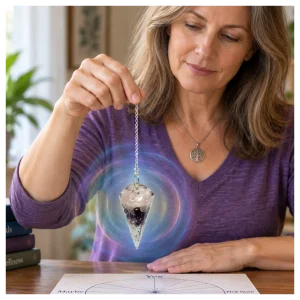
An orgone pendulum performs the same basic dowsing function as any other pendulum. It swings or rotates to provide the responses we interpret when asking questions. Pendulums made from brass, wood, crystal, glass, and many other materials can perform exactly the same function.
What makes an orgone pendulum different is not that orgonite necessarily makes it a better dowsing instrument. It is that the pendulum itself is also an energetic device.
I have always regarded this as the principal advantage of an orgone pendulum. The orgonite radiates an energetic influence that may affect the dowser; the subject being tested, or the immediate environment.
But the pendulum doesn’t have to be moving for that influence to exist.
An Energetic Device Even When It Isn’t Dowsing
If an orgone pendulum is carried in a pocket, worn around the neck, placed on a desk, or simply left in a room, I would still expect it to have an energetic influence within its effective radius.
In this respect, it is somewhat like carrying a crystal. A person doesn’t need to use a piece of rose quartz or amethyst as a dowsing instrument in order to experience the properties attributed to the stone. Its influence is considered inherent to the crystal itself.
The same principle should apply to an orgone pendulum. Its dowsing function and its energetic function are separate. The pendulum movement provides dowsing responses, while the orgonite continues interacting with and influencing its surrounding energetic field, whether the pendulum is moving or perfectly still.
This is another reason I don’t think the swinging of an orgone pendulum is necessary to activate the piezoelectric properties of the quartz. If an orgone pyramid or generator works while sitting motionless, an orgone pendulum should do the same.
The Influence May Extend Beyond the Dowser
When an orgone pendulum is actually used for dowsing, however, its location becomes interesting.
The pendulum is normally held close to the dowser and often directly over the person, object, substance, or other subject being tested. Its energetic field may therefore encompass more than the pendulum itself.
If the orgonite has a radiating influence, it could affect the dowser, the subject, the surrounding environment, or some combination of the three. The gemstones incorporated into the pendulum may further contribute their individual energetic characteristics.
This was what I meant when I considered an orgone pendulum to be enhanced. I wasn’t suggesting that the orgonite somehow makes the pendulum give more accurate answers or makes the person holding it a better dowser. The enhancement is the additional energetic influence of the orgonite itself.
But our investigation has now introduced a complication.
If an orgone device interacts with the energetic condition already present around it—and if it can potentially concentrate, modify, or even amplify that condition—can we automatically assume that its radiating influence will always be positive?
Earlier I would have answered yes. I’m no longer certain the answer is quite that simple.
Does an Orgone Pendulum Always Radiate Positive Energy?
Until I began questioning some of the explanations for how orgonite works, I assumed that the energetic influence of an orgone pendulum would always be positive. After all, one of the principal claims made for orgonite is that it transforms negative orgone into positive orgone and radiates that beneficial energy into its surroundings.
But if the model we’ve been exploring is correct, the answer may not be quite so simple.
If orgonite interacts with the energetic field already surrounding it, then the condition of that field may become part of the equation. An orgone pendulum in a positive environment may concentrate, amplify, or otherwise influence an already beneficial field. But what happens when the same pendulum is carried into a negative zone?
Does its construction automatically transform that negative condition into a positive one? Does it gradually help restore the natural flow and balance of the surrounding energy? Or could it initially concentrate or amplify some characteristics of the field already present?
At this point, I don’t think we can assume the answer.
Perhaps the Device and Environment Influence Each Other
We often think of an orgone device as the active component and its surroundings as the passive recipient. Energy comes into the device, something happens to it, and positive energy radiates outward.
But perhaps the relationship works in both directions.
The local aether/orgone field may influence the energetic condition of the orgonite, while the orgonite simultaneously influences the surrounding field. Its resin-and-metal matrix, gemstones, size, geometry, and overall construction could influence the nature and strength of that interaction.
This would help explain why an orgone device might test differently in different locations without necessarily meaning that the device itself has become permanently positive or negative.
It also raises a practical consideration for an orgone pendulum. Because it is portable, it is constantly being moved between energetic environments. It may be kept in a pocket, used in different rooms, held over different people or substances, or taken outside. If the surrounding field matters, the energetic interaction involving the pendulum may change as its environment changes.
Can an Orgone Pendulum Help Correct a Negative Zone?
There is another possibility that shouldn’t be overlooked. Even if an orgone device is influenced by the surrounding field, its construction may still have a normalizing or balancing effect upon that field.
This would fit the familiar observation that energetic remediation can change how a location tests. When I identify a negative zone while dowsing a house, the objective isn’t merely to label it negative. The next step is usually to determine what is causing the disturbance and whether the area can be corrected.
Removing clutter, changing the arrangement of a space, applying Feng Shui principles, or introducing energetic devices such as Lakhovsky coils or the ADR products I use can sometimes change the way an area subsequently tests.
Orgonite may work in a similar way. Rather than simply taking a quantity of DOR and converting it into POR, perhaps it changes the conditions that allow a disturbed energetic pattern to persist.
That would be a subtler meaning of transformation.
An Interesting Experiment
My earlier experience with orgone generators that tested both positively and negatively now suggests an experiment I wish I had performed at the time.
I would first identify clearly positive and negative locations without an orgone device present. I would then dowse the same orgone generator independently before placing it in each location. After allowing it to remain there, I would test both the generator and the surrounding area again.
Then I would move the same device between the positive and negative locations and repeat the procedure.
If the generator continued to test positive regardless of its surroundings while the negative area gradually became more positive, that would support the idea that the device has an inherently positive, normalizing influence.
If the generator changed from testing positive to testing negative according to its location, that would suggest the surrounding field is influencing the device.
And if both the way the generator tested and the way the location tested changed over time, we might be seeing a two-way interaction between the orgonite and its environment.
I haven’t performed this experiment, so I don’t know what the result would be. But I think asking the question is more useful than simply assuming that every piece of orgonite must continuously radiate POR regardless of where it is placed.
It may also bring us closer to understanding what an orgone pendulum actually adds to dowsing: not necessarily a better dowsing response, but an additional energetic interaction taking place between the pendulum, the dowser, the subject, and the surrounding environment.
Final Thoughts
When I began looking more closely at how orgone pendulums work, I wasn’t expecting to question so many of the explanations I had previously accepted. I still believe orgone pendulums have energetic properties beyond their function as dowsing instruments, but I am no longer convinced that the familiar explanation of DOR in, POR out tells the whole story.
Reich’s original concept of orgone was of a universal energy already present throughout nature and the atmosphere. His accumulator was intended to collect and concentrate that energy, not create it. Modern orgonite changed the construction considerably, replacing larger alternating layers with a dense mixture of resin and metal and, eventually, adding quartz, gemstones, coils, and other materials.
Those additions raise questions of their own.
I don’t think the crystals in an orgone pendulum are there simply because quartz is piezoelectric. I believe different gemstones have different energetic signatures, which is one of the reasons we choose particular gemstones for conventional crystal pendulums in the first place. I see no reason to assume those properties disappear when the stones are incorporated into orgonite.
I am also increasingly inclined to think that what Reich called orgone may be related to the more fundamental concept of aether—a universal energetic medium within which local conditions can vary. What we call positive and negative orgone may therefore represent different conditions or expressions of the same underlying energy rather than two separate forms of energy.
If that is the case, orgonite may have a more complex relationship with its surroundings than simply attracting negative energy and converting it into positive energy. It may concentrate, amplify, organize, modify, or help rebalance the energetic field around it, with the resulting influence depending upon both the environment and the materials from which the orgonite is made.
That possibility has also changed the way I interpret my own experience with orgone generators that tested both positively and negatively. I don’t yet know whether those devices had themselves become negative, were responding to the energetic zones in which they were located, or whether something else was occurring. Today, I would perform considerably more testing before drawing a conclusion.
So, What Is Special About an Orgone Pendulum?
For me, the answer is actually simpler than it once seemed.
An orgone pendulum doesn’t need to make someone a better dowser or provide more accurate answers in order to be useful. It combines a dowsing instrument with an energetic device.
When used for dowsing, it provides the same type of responses as another pendulum. At the same time, its orgonite and gemstones contribute an additional energetic influence involving the dowser, the subject being tested, and potentially the immediate surroundings.
And that influence isn’t dependent upon dowsing. The orgone pendulum could be carried in a pocket, worn around the neck, placed nearby, or left sitting on a table and still retain the energetic properties associated with its materials.
Exactly how far that influence extends, how strongly the surrounding environment affects it, and whether different orgonite constructions behave in the same way are questions I don’t think we can presently answer with certainty.
But perhaps that is the most useful conclusion from this investigation. We don’t have to discard the concept of orgone simply because some of the explanations for how orgonite works don’t completely add up.
Sometimes asking better questions doesn’t weaken an idea. It gives us a better opportunity to understand what may actually be happening.
Chakra Layered Orgone Pendulum
Rose Quartz & Amethyst & Clear Quartz Orgone Pendulum
PendulumsPlus
PendulumsPlus has been helping people explore dowsing, energy work, and complementary wellness for decades. We offer a carefully selected range of pendulums, dowsing rods, tuning forks, EMF protection products, shungite, and other specialty tools, supported by practical articles that share years of hands-on experience to help readers learn with confidence and make informed choices.
The Difference Between Dowsing and Divining I’ve often wondered: is there a difference between dowsing and divining? Do the terms mean the same thing, or are there subtle differences that set them apart? The two terms are frequently used interchangeably, and historically the distinction between them isn’t always clear. Yet, as a dowser, I’ve never felt that they describe quite
Locate Lost Items Using a Pendulum Losing something such as a wallet, set of keys, piece of jewelry, or important document can be frustrating—particularly when you’ve searched all the obvious places and still can’t find it. A pendulum offers another way of approaching the search. Rather than wandering from room to room hoping to spot the missing item, dowsing allows
How to Test Herbs Using a Pendulum In my previous blog post, we explored the intriguing world of testing vitamins with a pendulum. While vitamins and herbs are both widely used to support health, learning how to test herbs using a pendulum deserves its own discussion. Herbs are complex natural substances with unique energetic properties, making the dowsing process quite
How to Test Vitamins Using a Pendulum Many people use a pendulum to test vitamins as part of their personal wellness routine. Rather than choosing supplements based solely on general recommendations, pendulum dowsing offers a way to evaluate which vitamins, minerals, and nutritional supplements may be most suitable for you at a particular time. This approach is based on the
How to Test Food Using a Pendulum Learning how to test food using a pendulum can help you make more informed choices about the foods you eat. Whether you’re comparing fresh produce, packaged foods, or pantry staples, pendulum dowsing offers a simple way to evaluate vitality, energetic quality, and personal suitability. In this article, I’ll show you practical techniques for
How to Predict Baby Gender Using a Pendulum Expectant parents are often curious about the gender of their unborn baby. Whether the curiosity is simply for fun or part of a family tradition, many methods have been used over the years to predict whether a baby is a boy or a girl. While modern medical techniques provide the most reliable


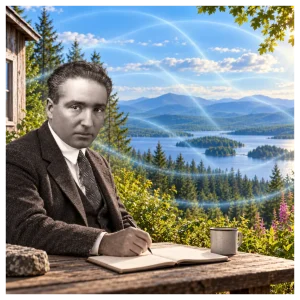 The concept of orgone energy originated with Austrian physician and psychoanalyst Wilhelm Reich. His early work grew out of psychoanalysis and his interest in the relationship between emotional states, the body, and biological energy. By the late 1930s, his research had led him to conclude that he was observing a form of energy different from electricity, which he eventually named orgone energy.
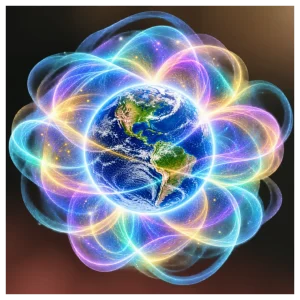 Reich believed that orgone could exist in different states. Free-flowing, life-supporting orgone became known as Positive Orgone Energy (POR), while he used the term Deadly Orgone Energy (DOR) to describe a disturbed or harmful state of orgone.
 Natural geological features and geopathic lines may be one source of influence. Building materials, room configuration, electrical wiring and electromagnetic fields may contribute others. Clutter and restricted movement through a space may affect its energetic flow. The people and other living organisms occupying the environment may introduce still more influences.
 Reich’s experiments with orgone eventually led to the development of the orgone energy accumulator. These devices used alternating layers of nonmetallic insulating and metallic materials, commonly including fiberglass or similar insulating material together with steel wool, with a metal-lined interior. Reich believed that the different materials interacted with atmospheric orgone in different ways, causing the energy already present in the environment to become concentrated within the accumulator.
 Does Resin Keep Quartz Electrically Active?
 This raises an interesting question when the same stones are incorporated into an orgone pendulum. If rose quartz or amethyst retains its individual energetic signature when used as a conventional crystal pendulum, why would those properties disappear when the stone is embedded in orgonite?
 An orgone pendulum performs the same basic dowsing function as any other pendulum. It swings or rotates to provide the responses we interpret when asking questions. Pendulums made from brass, wood, crystal, glass, and many other materials can perform exactly the same function.
 But if the model we’ve been exploring is correct, the answer may not be quite so simple.