Egyptian Pendulums and Why You Want One
Egyptian pendulums are among the most distinctive and intriguing instruments used in dowsing. Yet the deeper we look into the origins of the pendulum itself, the more mysterious its history becomes. Suspended weights have existed for thousands of years and appear in different forms across ancient civilizations, but exactly when people began using them for divination or spiritual purposes is much harder to establish.
Ancient Egyptians certainly understood the practical value of a suspended weight. The plumb line helped builders establish a true vertical when constructing their remarkable temples and monuments. It is tempting to imagine the plumb bob as an ancestor of the modern dowsing pendulum, but there is little evidence to demonstrate such a progression. The two may simply represent very different uses of the same remarkably simple principle.
That leaves a fascinating question. How did people first discover that a weight suspended from a cord could be used for something other than measurement? Was its subtle movement discovered through observation and experimentation? Did it develop independently within spiritual practices? Or, as some esoteric traditions suggest, was knowledge of such instruments passed down or taught? We simply don’t know.
Today, some of the best-known Egyptian pendulums carry names such as Karnak, Isis and Osiris. Their distinctive forms have become associated within radiesthesia with particular qualities and uses. Whether you are attracted by their unusual designs, their traditional energetic properties, their connection with ancient Egypt, or simply want to experiment with something different, Egyptian pendulums offer a fascinating branch of dowsing to explore.
The Different Types of Egyptian Pendulums
Egyptian pendulums are not a single design. The best-known include the Karnak, Isis and Osiris, along with variations and hybrids that combine features of these traditional forms. Each has a distinctive shape, balance and character that sets it apart from a conventional pendulum.
Within dowsing traditions, these differences in form are considered more than decorative. Individual designs have acquired reputations for particular qualities and uses—some for their sensitivity, others for their ability to concentrate or direct energy, and some for more specialized applications.
Let’s look at the best-known Egyptian pendulums and what makes each one distinctive.
The Karnak Pendulum
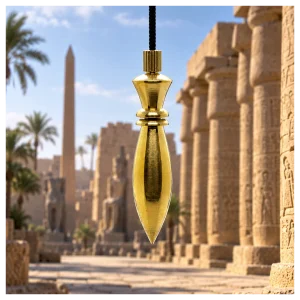
The Karnak pendulum is one of the classic Egyptian pendulum designs and is named after the great temple complex at Karnak. Its distinctive elongated and carefully proportioned form is traditionally associated with the Ankh, the ancient Egyptian symbol commonly known today as the “Cross of Life.”
An intriguing story surrounds its origin. The Karnak design is said to be based on a sandstone pendulum discovered in a sarcophagus at Karnak. You will find this account repeated in descriptions of the pendulum, although documentation establishing the archaeological history behind the story is difficult to find. Like so much surrounding the origins of Egyptian pendulums, the story has become part of their enduring mystery.
As a dowsing instrument, the Karnak is particularly versatile. It is traditionally used for both receiving and sending, as well as general inquiries, searching, map dowsing and other forms of investigative work. Its reputation as an all-purpose pendulum makes it an interesting choice for someone who wants to explore an Egyptian design without necessarily choosing a pendulum intended for a more specialized purpose.
Within traditional descriptions of Egyptian pendulums, the proportions and polarization of the Karnak are considered important to its performance. It is also said to be self-clearing rather than retaining unwanted influences from previous work. These are characteristics a dowser can explore through personal use rather than simply accepting them on reputation.
The Isis Pendulum
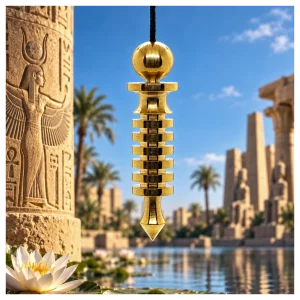
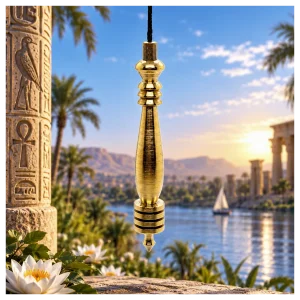
The Isis pendulum is one of the most recognizable Egyptian pendulums. Its slender body is divided by a series of radial plates or discs, sometimes referred to as solar discs or batteries. These are not merely decorative features. Within traditional dowsing practice, the discs are considered an important part of the pendulum’s sensitivity and its ability to both receive and transmit subtle energy.
Different versions of the Isis may have different numbers of discs. The classic Isis has four, while designs such as the Super Isis may have six or more. Traditionally, increasing the number or size of these discs is believed to increase the strength or sensitivity of the pendulum. This makes the Isis an interesting example of an Egyptian pendulum in which form is considered part of its function.
The Isis is considered an all-purpose pendulum. It can be used in the familiar way for asking questions, testing foods, supplements or other substances, searching for information and general dowsing. But the Isis is also traditionally regarded as both a receiver and transmitter, which has led to its use for energy work. Rather than thinking of the pendulum itself as performing healing, I prefer to think of it as an instrument through which the dowser can focus and direct intention or energy toward a particular purpose.
Another interesting characteristic attributed to the Isis is its association with white radiesthetic light. In this context, “white light” doesn’t mean visible light or electromagnetic radiation that we could measure with an ordinary instrument. It is a term used within radiesthesia to describe a particular subtle energetic quality. The Isis is consequently described as self-clearing and is generally considered not to require the energetic cleansing often recommended for some other pendulum designs.
The pendulum takes its name from Isis, one of ancient Egypt’s most important goddesses, associated with motherhood, magic, protection and healing. The Isis pendulum is also traditionally associated with the Ankh or “Cross of Life.” How much of the pendulum’s design can genuinely be traced to ancient Egypt is much less certain. Claims have also been made that the design is pre-Egyptian or even Atlantean. There is little historical evidence with which to establish such an origin, but those traditions form part of the larger mystery that has grown around Egyptian pendulums.
The Osiris Pendulum
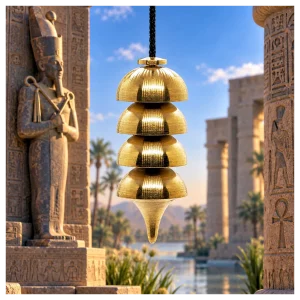
The Osiris pendulum is one of the more unusual and specialized Egyptian pendulums. Its body consists of a series of rounded sections that lead downward toward a sharply defined point. Within dowsing traditions, this geometry is considered important: the shape is said to concentrate and direct energy toward the point rather than simply serving as a decorative design.
Unlike the Isis, which is generally regarded as a versatile receiving and transmitting pendulum, the Osiris has acquired a reputation as a more powerful and specialized instrument. It is particularly associated with broadcasting, focused intention and transformational energy work. Some practitioners consequently regard it as a pendulum better suited to an experienced dowser than someone simply learning to obtain yes-and-no responses.
The name Osiris adds another fascinating dimension. Osiris was one of the most important gods of ancient Egypt, associated with fertility, death, resurrection, and regeneration. According to the Osiris myth, he was killed by his brother Seth, and his body was restored by his wife and sister Isis. Osiris subsequently became ruler of the realm of the dead and an important Egyptian symbol of renewed life after death.
There is an interesting parallel between this symbolism and the qualities later attributed to the Osiris pendulum. Within radiesthesia, the pendulum is particularly associated with Negative Green, a radiesthetic vibration traditionally connected with preservation, concentration, and powerful effects upon living matter. Despite its name, Negative Green does not simply mean negative or harmful energy, nor does “green” refer straightforwardly to the visible color green. It belongs to a much more elaborate system of radiesthetic colors and energies developed by researchers such as André de Bélizal and Léon Chaumery.
Negative Green is a subject considerably more complex than its name suggests. Different forms and applications have traditionally been described as having either constructive or potentially harmful effects. This helps explain some of the seemingly contradictory advice surrounding the Osiris: it has been described as a powerful instrument for energy work while at the same time being accompanied by warnings about careless or prolonged use.
For this reason, traditional instructions for the Osiris often recommend that it not be left suspended over a person, animal, or other living thing when it is not being intentionally used. Some instructions also recommend dismantling the pendulum during long periods of storage and cleansing it after energy work. These recommendations belong to the radiesthesia tradition surrounding the instrument rather than established physical effects, but they are worth knowing if you choose to work with an Osiris.
Perhaps the most intriguing aspect of the Osiris is the correspondence between its name and its traditional reputation. Osiris, the god represented death followed by regeneration and renewed life; the Osiris pendulum became associated with preservation, transformation and concentrated Negative Green. Whether that relationship was intentional when the pendulum was designed or developed later as part of its radiesthetic tradition is difficult to establish. Nevertheless, it adds another layer to the mystery surrounding Egyptian pendulums.
The Mer-Isis Pendulum
The Mer-Isis pendulum is an interesting variation within the Egyptian pendulum family. It retains several recognizable characteristics of the Isis, particularly its radial or “solar” discs, but combines them with a substantially different lower section intended for collecting, concentrating and directing subtle energy.
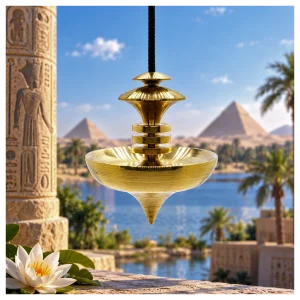
The version I use has three solar discs, two concave sections and a broad collector plate terminating in a rounded directional point. Within dowsing traditions, these features are considered functional rather than merely decorative. The discs are associated with sensitivity and transmission, while the lower sections are intended to collect and concentrate energy before directing it toward the subject.
Exactly where the Mer-Isis design originated is difficult to establish. Some descriptions suggest that it combines characteristics of both the Mermet and Isis pendulums, which could also explain the name Mer-Isis. However, these designs have been reproduced and modified by many manufacturers over the years, and Mer-Isis pendulums can differ noticeably in their proportions and construction. Without documentation from the original designer, its precise lineage remains uncertain.
Although the Mer-Isis performs conventional dowsing tasks such as asking questions, working with charts, mapping and investigating information, it is particularly associated with energy work. Its construction has given it a reputation as a strong transmitting or projecting pendulum, used with focused intention to collect, concentrate and direct subtle energy toward a particular purpose.
For this reason, the Mer-Isis is popular with dowsers who incorporate pendulums into healing and other forms of subtle-energy work. As with the Isis, I don’t regard the pendulum itself as performing the healing. The dowser remains an active participant, while the pendulum may serve as an instrument through which intention and energy are focused and directed.
Another unusual characteristic attributed to the Mer-Isis concerns radiesthetic colors. Traditional descriptions associate the design particularly with purple, white and gold. These aren’t visible colors produced by the pendulum, but subtle energetic qualities described within radiesthesia. Whether or not you work with radiesthetic colors yourself, they illustrate the broader tradition in which the geometry of a pendulum is believed to influence the qualities of energy with which it interacts.
The Mer-Isis therefore occupies a somewhat different place from the Karnak, Isis and Osiris. Its connection with Egyptian pendulums comes primarily through the Isis characteristics incorporated into its design, rather than through any established ancient Egyptian origin. It also demonstrates how traditional pendulum forms have continued to evolve, with features from different designs being combined to create instruments intended for more specialized applications.
For someone already familiar with a conventional pendulum—or even an Isis—the Mer-Isis offers something quite different to experiment with. Its unusual construction, weight and balance, together with its traditionally attributed energetic characteristics, make it an intriguing choice for a dowser interested in exploring whether the form of a pendulum influences the way it works in practice.
The Renova Pendulum
The Renova pendulum is another example of how the characteristic forms of Egyptian pendulums have inspired later designs. Unlike the Isis or Osiris, it is not named after an Egyptian god, nor does its name refer to an Egyptian place such as Karnak. Its connection with the Egyptian pendulum family comes instead through its distinctive geometry.
Its long, slender body is reminiscent of the Karnak, while the three rounded segments toward the upper portion suggest something of the Osiris design. Lower down, four more sharply defined radial plates resemble the “solar discs” or batteries associated with the Isis. Whether the original designer deliberately intended all three connections is difficult to establish, but the Renova certainly brings together several characteristics familiar from Egyptian-style pendulums.
The elongated form itself is significant within radiesthesia. Traditional radiesthetic theory gives considerable importance to shape, proportion and orientation, with slender forms generally regarded as helping to concentrate and direct subtle energies along the axis of the instrument. The Renova’s narrow body, radial elements and defined lower point therefore form part of its traditionally attributed function rather than simply giving it an attractive appearance.
Interestingly, the name Renova derives from the Latin renovare, meaning to renew or restore. We don’t know whether this meaning was deliberately chosen by the original designer, but it corresponds remarkably well with the qualities attributed to the pendulum: renewal, restoration, regeneration and the rebalancing of subtle energies.
The Renova is a versatile pendulum that can be used for general questions, detection work and other conventional dowsing assignments. It has developed a particular reputation, however, for remote dowsing and energy balancing. Practitioners may use it when working with someone at a distance or when investigating and attempting to restore balance within the chakras and what various energy traditions describe as the subtle bodies.
Like the Isis, the Renova is traditionally associated with White Light within the radiesthetic spectrum. It is also described as self-clearing, meaning that practitioners generally consider it less likely to retain unwanted energetic influences from previous work.
Another interesting aspect of the Renova is its association with principles developed by French radiesthesia researchers Léon Chaumery and André de Bélizal. Some descriptions identify part of its construction with a three-element radiesthetic “battery,” reflecting their investigations into ondes de forme, or waves of form. Their work explored the idea that particular shapes, proportions and orientations could produce distinctive radiesthetic effects.
We don’t need to explore that theory in detail here, but it helps explain something important about Egyptian and Egyptian-inspired pendulums: their unusual shapes were not necessarily created simply for appearance. Within radiesthesia, the geometry itself is considered an active part of the instrument.
The Renova therefore occupies a somewhat different position from the Karnak, Isis and Osiris. It is better described as an Egyptian-inspired radiesthesia pendulum than as a traditional Egyptian design. Yet its combination of a slender elongated body, rounded segments and radial plates makes it an interesting example of how characteristics associated with several established pendulum forms can be brought together in a newer instrument.
For someone interested in Egyptian pendulums but wanting an instrument particularly associated with restoration, balancing and energy work, the Renova offers a distinctive alternative to the more traditional designs.

What About Lapis Lazuli Pendulums?
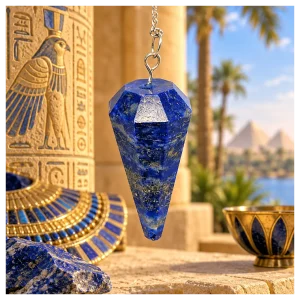
Not every pendulum with a connection to ancient Egypt belongs to the traditional Egyptian family of pendulum designs. Lapis lazuli pendulums are a good example. Their connection with Egypt comes not primarily from their shape, but from the extraordinary importance of the stone itself within ancient Egyptian culture.
Lapis lazuli was highly prized by the ancient Egyptians and used in jewelry, amulets and decorative objects, including treasures associated with Egyptian royalty. Its deep blue color, often flecked with golden pyrite, gave it a particularly rich and distinctive appearance. The stone also acquired associations with royalty, protection, wisdom and the divine.
A lapis lazuli pendulum therefore offers a very different way of connecting dowsing with ancient Egypt. Rather than working with the specialized geometry of an Isis, Osiris or Karnak, the attraction lies primarily in the stone itself and the qualities traditionally attributed to it.
For someone particularly drawn to Egyptian symbolism, gemstones or the rich blue and gold appearance of lapis lazuli, it can be an appealing alternative—or companion—to the more specialized Egyptian pendulum designs.
Why Are People Drawn to Egyptian Pendulums?
There is something about ancient Egypt that continues to capture the imagination. Its temples, pyramids, hieroglyphs and extraordinary religious traditions suggest a civilization deeply interested in the relationship between the physical and spiritual worlds. For some people, an Egyptian pendulum carries a little of that mystery with it.
Part of the attraction is undoubtedly visual. Egyptian pendulums look different. Their elongated bodies, carefully arranged discs, rings and geometric proportions give them a distinctive appearance that separates them immediately from a conventional pointed crystal or metal pendulum. Within radiesthesia, however, these shapes are traditionally considered functional as well as decorative.
For others, the attraction goes considerably deeper. Over the years, I have encountered people who feel a powerful personal connection with ancient Egypt. Some describe it simply as fascination or spiritual affinity, while others interpret it through beliefs about reincarnation and past lives. I have even met people who believe they lived in Egypt—or in an earlier civilization such as Atlantis—and who consequently feel naturally drawn to Egyptian symbols and instruments.

There is no way to establish such experiences historically, but that doesn’t make the attraction itself any less real to the person experiencing it. Sometimes we are drawn to a particular pendulum before we can explain why.
Ancient Egypt also leaves us with unanswered questions. We know that its builders possessed remarkable skills in mathematics, surveying, stonework and astronomy, while its religious culture placed enormous importance on unseen aspects of existence, the continuation of life after death and the relationship between human beings and the divine. Beyond what archaeology can tell us, numerous esoteric traditions have proposed that Egyptian priests or mystery schools preserved knowledge inherited from still earlier civilizations.
Whether one regards those ideas as history, spiritual tradition or speculation, they have become part of the larger mystery surrounding Egypt. Egyptian pendulums sit naturally within that world of ideas—not because we can demonstrate that an Isis or Osiris pendulum was used by an Egyptian priest thousands of years ago, but because their forms, names and later radiesthetic traditions continue to evoke that connection.
Ultimately, choosing a pendulum is a very personal matter. Its weight and balance may attract you, its design may interest you, or you may simply feel that one particular instrument is the one you want to work with. With Egyptian pendulums, that sense of attraction can be particularly strong.
Which Egyptian Pendulum Should You Choose?
Choosing an Egyptian pendulum doesn’t necessarily mean finding the one that is best. The different designs have developed reputations for different characteristics, and the right choice depends largely upon what you want to explore.
If you want a versatile Egyptian pendulum for everyday dowsing, the Karnak is a good place to begin. Its relatively simple design makes it suitable for questions, searching, map dowsing and general investigative work, while still allowing you to experiment with the characteristics traditionally associated with Egyptian pendulums.
The Isis is also highly versatile, but takes you further into the energetic side of dowsing. Its radial discs and association with receiving and transmitting make it particularly interesting if you want to experiment with energy work, testing substances, chakras or radiesthetic colors while retaining a pendulum that can still perform ordinary dowsing tasks.
The Osiris is the more specialized choice. Its concentrated geometry and association with Negative Green make it particularly interesting for an experienced dowser wanting to investigate radiesthetic energies, broadcasting and focused energy work. Because of the traditional precautions associated with the Osiris, I wouldn’t necessarily choose it as someone’s first pendulum.
If you already have experience with conventional pendulums and want something more unusual, the Mer-Isis combines familiar Isis characteristics with a heavier collector and directional design. It is particularly suited to someone interested in experimenting with collecting, concentrating and directing subtle energy.
The Renova is another interesting alternative, particularly if your interests lean toward balancing and restorative energy work. Its Egyptian-inspired geometry combines several familiar design elements, while its traditional association with White Light and remote work gives it a character of its own.
And don’t overlook the importance of simply being attracted to a particular pendulum. You may prefer the weight of one design, the balance of another, or find yourself repeatedly returning to a pendulum without being able to explain why. Dowsing is experiential. Sometimes the most useful way to discover whether a particular design makes a difference is simply to work with it and make your own observations.
Final Thoughts
Egyptian pendulums offer something quite different from the conventional pendulum. You can certainly use them for familiar dowsing tasks, but their unusual geometry also opens the door to a much broader tradition in which shape, proportion and construction are believed to influence how a pendulum receives, concentrates and directs subtle energy.
You don’t have to accept every claim surrounding Egyptian pendulums to find them fascinating. In fact, part of their appeal is experimentation. Does an Isis respond differently from your ordinary pendulum? Can you detect a difference between an Isis and an Osiris? Does the weight, balance or geometry of a Karnak affect the way you dowse? These are things you can investigate for yourself.
Their history also leaves us with intriguing unanswered questions. We cannot confidently trace today’s Karnak, Isis or Osiris pendulums back to instruments used by the ancient Egyptians, yet their forms have become firmly established within modern dowsing and radiesthesia. A tradition has grown around them involving subtle energies, radiesthetic colors, healing, broadcasting and the energetic effects of shape.
Perhaps that combination of practical dowsing, unusual geometry and enduring mystery is what makes Egyptian pendulums so compelling. Whether you’re attracted to their connection with ancient Egypt, interested in their traditional energetic properties, or simply curious to discover whether a different pendulum changes your dowsing experience, there is really only one way to find out:
Choose one that appeals to you, work with it, and make your own observations.