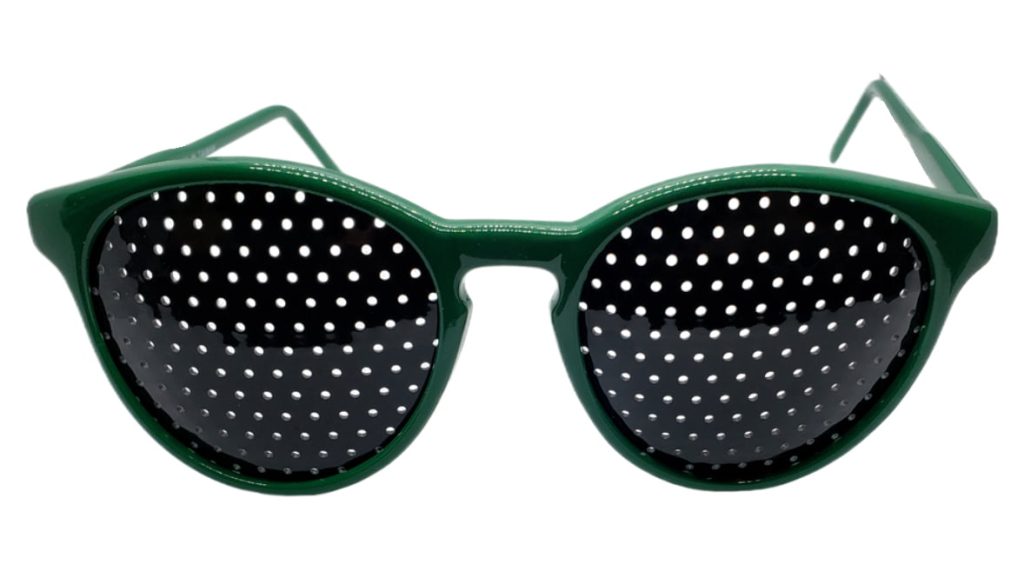
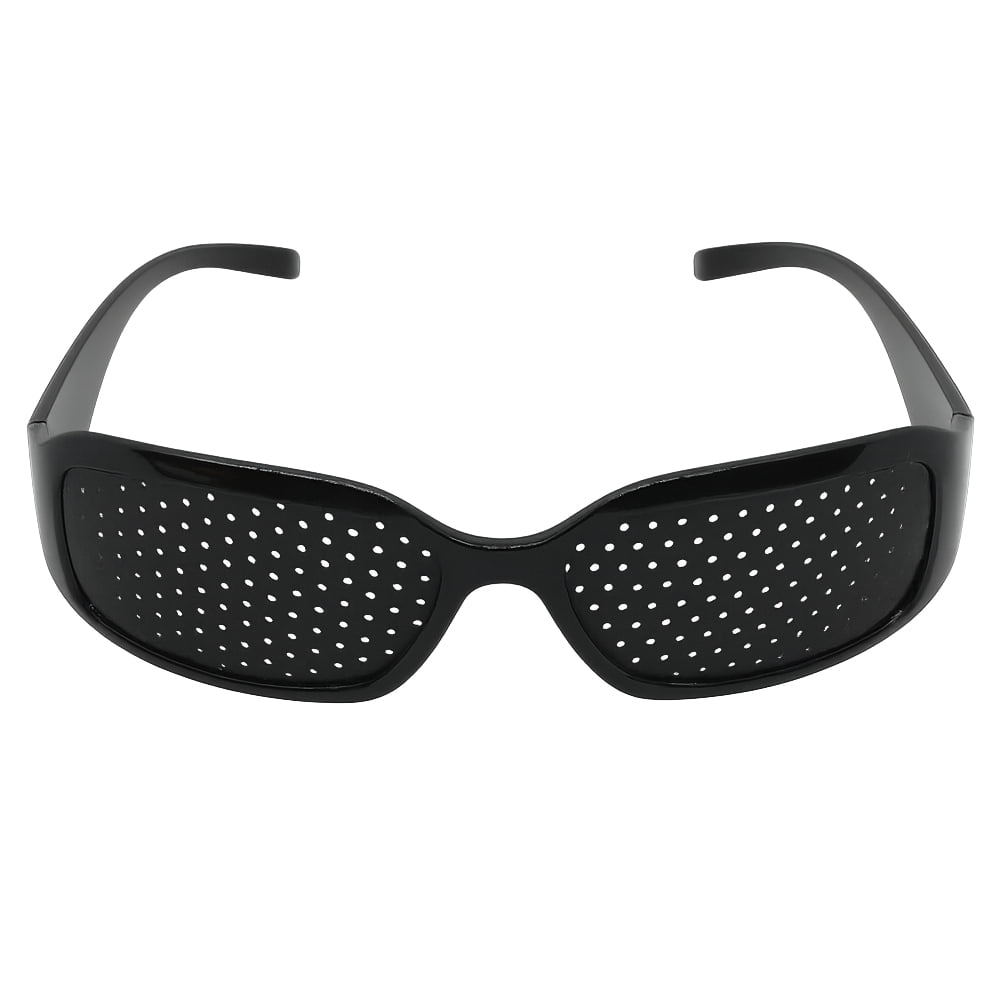
Pinhole Glasses for Near and Far Vision

Unisex Sports Style Pinhole Glasses for Near and Far Vision improve vision clarity and resolution for refractive eye disorders, increase object brightness for low-light situations, and enable clear vision at all distances without the pincushion effect. They activate natural vision ability, reduce eyestrain, and promote relaxation, making them ideal for students, computer users, and aged individuals. Suitable for myopia, hyperopia, presbyopia, astigmatism, and cataracts.

Pinhole Glasses offer a solution for anyone wanting to improve their vision naturally.

Comes with FREE protective pinhole glasses pouch.

$15.99

Pinhole Glasses for Near and Far Vision

SKU UTF13 Categories ,

Description

Unisex Sports Style Pinhole Glasses for Near and Far Vision

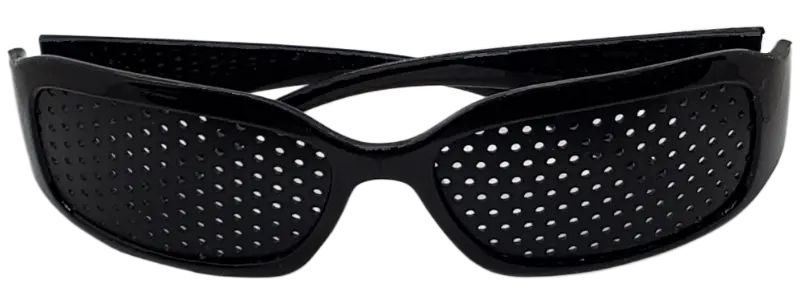
These unisex pinhole glasses are designed in a sporty wraparound style, ideal for both nearsighted and farsighted users. The lightweight black frame ensures all-day comfort, while the precision perforations may help train your eyes to focus naturally—making them a perfect alternative tool for vision improvement exercises or screen relief.

Unisex Sports Style Pinhole Glasses for Near and farsighted Vision.

Product Features

  • Unisex Sports Style Design – Modern wraparound frame fits comfortably for both men and women.

  • Improves Vision Clarity & Resolution – Helps correct refractive eye conditions such as myopia, hyperopia, presbyopia, astigmatism, and cataracts.

  • Enhances Low-Light Vision – Increases object brightness and contrast in dim environments.

  • See Clearly at All Distances – Promotes sharp vision without the typical pincushion distortion found in some corrective lenses.

  • Supports Natural Vision Training – Stimulates the eyes’ natural focusing ability, making it ideal for those seeking non-invasive, natural vision improvement.

  • Reduces Eyestrain & Fatigue – Perfect for students, computer users, and seniors who experience visual stress throughout the day.

  • Promotes Visual Relaxation – Encourages healthier vision habits without reliance on prescription eyewear.

🎁 Bonus: Comes with a FREE protective pinhole glasses pouch.

What is Farsightedness or Hyperopia?

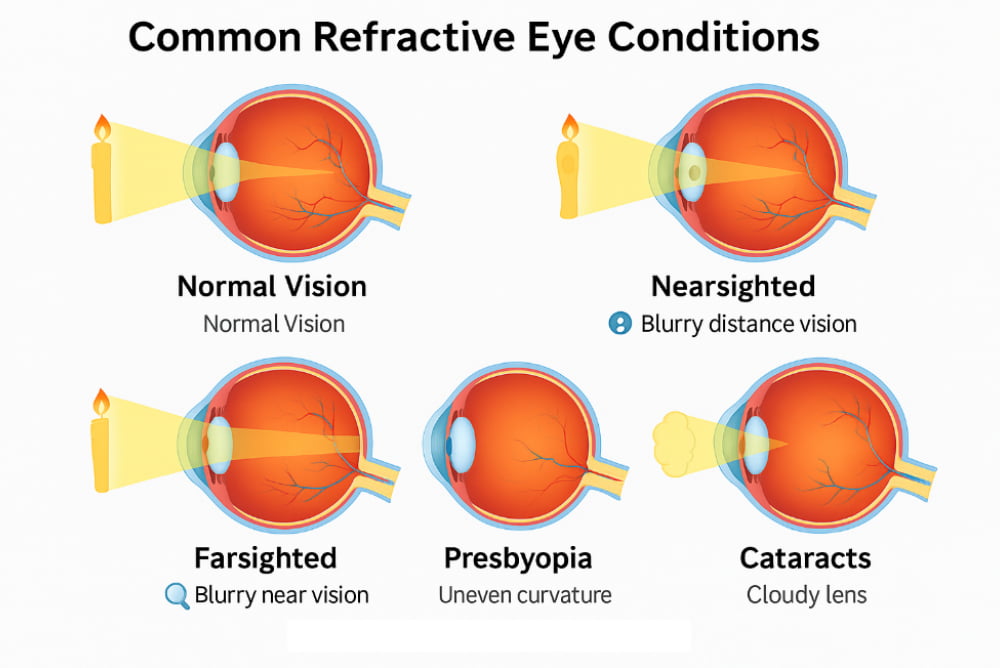
Farsightedness, also known as hyperopia, is a common vision condition where distant objects can be seen more clearly than nearby objects. This condition arises from the eye’s refractive system, which involves the cornea and lens focusing light directly onto the retina at the back of the eye.

In individuals with hyperopia, the eye is shorter than normal or the cornea is too flat, causing light to focus behind the retina instead of on it. This misalignment results in nearby objects appearing blurry while distant objects remain relatively clear.

Symptoms and Signs of Farsightedness?

Eye Chart - Common Refractive Eye Conditions.The symptoms and signs of farsightedness (hyperopia) are primarily related to difficulties in seeing objects at close range. These include:

  1. Blurred Vision for Close Objects: The most common symptom is difficulty focusing on objects that are near. This might mean that reading, writing, or other tasks that require close vision can cause blurriness.

  2. Eye Strain: People with hyperopia often unconsciously exert extra effort to clear their blurry vision, leading to strain. Symptoms of eye strain include sore or irritated eyes and fatigue.

  3. Headaches: Frequently, the strain on the eyes from trying to focus on nearby objects can lead to headaches. These headaches often occur after prolonged periods of performing tasks that involve close vision, such as reading or using a computer.

  4. Squinting: Individuals with hyperopia may squint in an attempt to see more clearly. Squinting reduces the extra light entering the eye, which can sometimes temporarily improve the clarity of vision for close objects.

  5. Difficulty with Night Vision: Though less common, some individuals with hyperopia may also have difficulty focusing or experience blurred vision in low light conditions.

  6. Aching Eyes, Discomfort, or a Burning Sensation: Due to the constant effort to maintain a clear focus on nearby objects, individuals with hyperopia might experience general discomfort around the eyes.
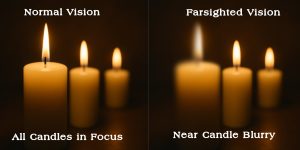
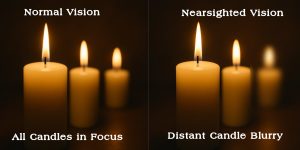
Using candles to show normal vision compared to hyperopia or farsighted vision.Children with mild-to-moderate farsightedness can see both close-up and at a distance without needing correction. This happens because the muscles and lenses in their eyes are flexible and they squint to overcome the farsightedness. However, as the child ages into adulthood, it becomes much more difficult for the eyes to adjust and hyperopia becomes an ongoing problem.

It’s important to note that these symptoms can also be associated with other eye conditions, so a proper diagnosis by an eye care professional is crucial. If you or someone you know is experiencing these symptoms, it’s advisable to get a comprehensive eye examination to determine the exact cause and discuss potential treatment options.

What is Nearsightedness or Myopia?

Candles used to illustrate normal vision vs myopia or nearsighted vision.Myopia, commonly known as nearsightedness, is a vision condition in which people can see close objects clearly, but objects farther away appear blurred. It occurs when the shape of the eye causes light rays to bend (refract) incorrectly, focusing images in front of your retina instead of on your retina.

According to the World Health Organization, myopia and high myopia effect 200 million people around the world. Approximately 50% of reported cases are in Asian countries with lower distribution spread throughout North and South America, Europe, and Australia. It’s roughly estimated myopia and high myopia will affect close to 50% of the world’s population by 2050.

This condition typically arises from one of two factors or a combination of both:

  1. The eyeball is too long, relative to the focusing power of the cornea and lens of the eye. This means that when light enters the eye, the image is focused in front of the retina instead of directly on it.
  2. The cornea and/or lens is too curved for the length of the eyeball. Similar to the first point, this curvature causes light to be focused in front of the retina.

Typically, myopia starts in childhood and the risk of suffering this disease is higher if the parents are nearsighted. Generally, nearsightedness stabilizes in early adulthood, although it may progress with age.

Myopia Symptoms and Signs

Symptoms and signs of myopia (nearsightedness) typically manifest as difficulties with distance vision. People with myopia often experience the following:

  1. Blurred Vision for Distant Objects: This is the hallmark symptom of myopia. People with myopia see close objects clearly but struggle to see things far away. For example, they may have difficulty reading road signs while driving but can read a book or use a computer without any problem.

  2. Squinting: Squinting reduces the size of the blurred image on the retina, temporarily improving vision clarity. People with myopia may squint frequently to see distant objects more clearly.

  3. Eyestrain or Headaches: Straining to see things at a distance can lead to discomfort. Overexertion of the eyes to focus on distant objects can result in headaches or a feeling of fatigue in the eyes, especially after prolonged periods of activities like driving or watching TV.

  4. Needing to Sit Closer: Children with myopia, in particular, might need to sit closer to the television, movie screen, or the front of the classroom. They may also hold books or other reading materials closer than normal.

  5. Poor Night Vision: Difficulty seeing in low light conditions or at night can also be a symptom of myopia. This is because the pupil dilates in low light, and a larger pupil can exacerbate focusing problems.

  6. Excessive Blinking or Rubbing Eyes: This can be a sign of eye strain resulting from the effort required to focus on distant objects.

A Natural Solution for Both Nearsightedness and Farsightedness

Couple showcasing unisex sports style pinhole glasses for near and far vision.The new Unisex Sports Style Pinhole Glasses offer a natural, non-invasive way to support and improve vision—whether you struggle to see things up close (farsightedness) or at a distance (nearsightedness). Unlike conventional eyeglasses or contact lenses that compensate for refractive errors, pinhole glasses work by training your eyes to focus more effectively, helping reduce strain and encouraging better visual habits.

If you find yourself squinting to read fine print, or straining to make out distant signs or screens, these versatile pinhole glasses may help. They’re especially useful for short daily sessions of visual training to refresh tired eyes and support sharper focus.

A Time-Tested Method Rooted in History

Pinhole vision training is far from new. Techniques to improve eyesight without prescription lenses date back thousands of years. Ancient practitioners like Patanjali, a revered Indian yogi, developed methods to tone and condition the extraocular muscles of the eyes. Similarly, in 7th-century Greece, physician Paulus Aegineta used vision-restricting masks to improve alignment and focus.

By narrowing the light that enters your eyes, pinhole glasses naturally reduce optical distortion and increase depth of field—helping your visual system reset and realign.

Why Choose These Glasses?

  • Unisex sports style: Comfortable, lightweight, and designed to fit most face shapes

  • Supports both near and far vision: One pair does it all

  • No prescription required: Use during reading, screen time, or visual exercises
  • Backed by ancient principles: A modern take on timeless methods of eye training

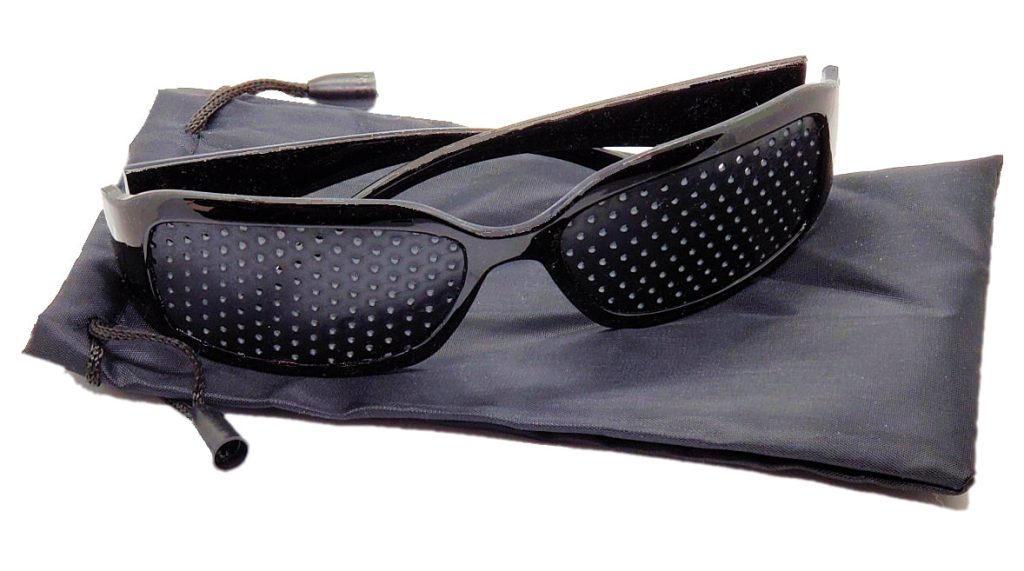
Pinhole Glasses Size: 14.0 cm x 4.0 cm x 12.0 cm.

Weight: 23.0 gm.

Comes with FREE pinhole glasses protective pouch.

Pouch Size: 17.0 cm x 9.0 cm x 2.0 cm.

Weight: 5.0 gm

Pinhole Glasses with Protective Pouch.
Unisex Sports Style Pinhole Glasses for Near and Far Vision
Close-up of a woman reading while wearing pinhole glasses.
A great way to improve vision naturally
Childrens Pinhole Glasses.
Children's Pinhole Glasses
Boy and girl in class wearing pinhole glasses.
We have Pinhole Glasses for Children

Please note: Pinhole glasses are NOT recommended for driving and should only be used as a training tool in a safe environment.

Additional information

Weight .035 kg
Dimensions 20.0 × 11.0 × 5.0 cm

Reviews

There are no reviews yet.

Be the first to review “Pinhole Glasses for Near and Far Vision”

Your email address will not be published. Required fields are marked *